Consul
Consul is used for service governance under microservices. Its main features include service discovery, service configuration, health checks, key–value storage, secure service communication, and multi–datacenter support.
This article is based on the latest component implementation. It introduces Consul client configuration and usage, along with the unified abstract service discovery capability.
Related information:
| Description | |
|---|---|
| Can be used for standard projects | ✅ |
| Can be used for Serverless | ❌ |
| Can be used for integration | ✅ |
| Contains independent main framework | ❌ |
| Contains independent logs | ❌ |
From v4, the Consul component is refactored based on Service Factory with significant API changes and provides abstract service discovery capabilities.
Thanks to boostbob for the component.
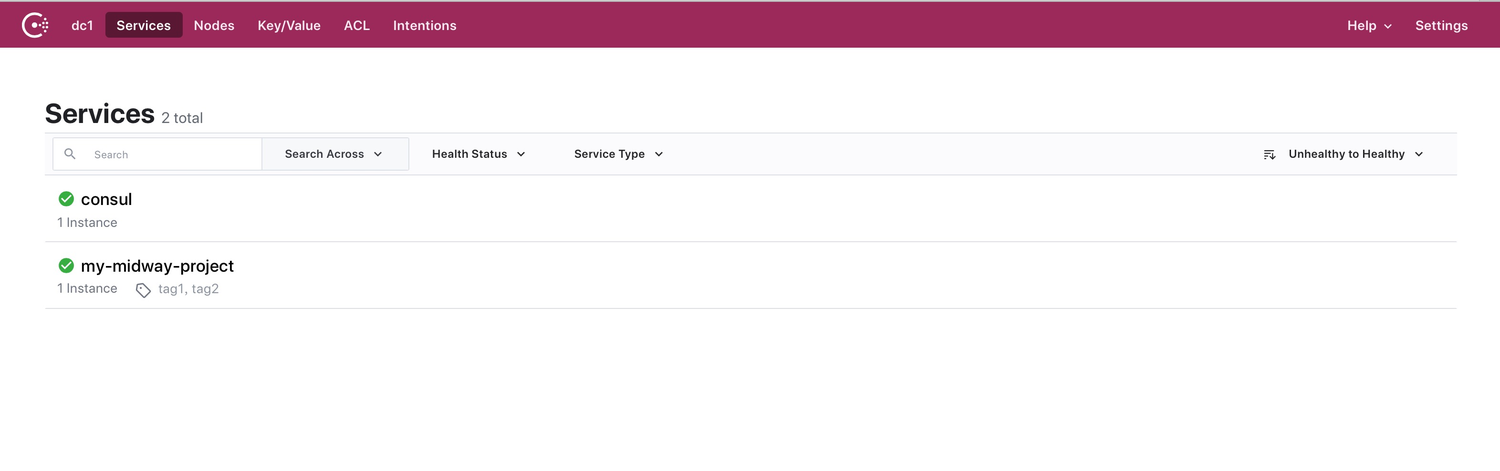
The effect is as follows:

Install Component
First install the Consul component:
$ npm i @midwayjs/consul@4 --save
Or add the following dependency to package.json and reinstall.
{
  "dependencies": {
    "@midwayjs/consul": "^4.0.0",
    // ...
  }
}
Import Component
import { Configuration } from '@midwayjs/core';
import * as consul from '@midwayjs/consul';
import { join } from 'path';

@Configuration({
  imports: [consul],
  importConfigs: [join(__dirname, 'config')]
})
export class MainConfiguration {}
Configure Client
Supports single-client and multi-client setups, following the ServiceFactory configuration structure.
Single client
// src/config/config.default.ts
export default {
  consul: {
    client: {
      host: '127.0.0.1',
      port: '8500'
    }
  }
}
Multiple clients
// src/config/config.default.ts
export default {
  consul: {
    clients: {
      a: { host: '127.0.0.1', port: '8500' },
      b: { host: '127.0.0.1', port: '8501' }
    },
    defaultClientName: 'a'
  }
}
Use default instance
ConsulService proxies the default instance and exposes the native Consul client methods directly.
import { Provide, Inject } from '@midwayjs/core';
import { ConsulService } from '@midwayjs/consul';

@Provide()
export class UserService {
  @Inject()
  consul: ConsulService;

  async register() {
     await this.consul.kv.set('name', 'juhai');
  }
}
Get a named instance
Use ConsulServiceFactory to fetch a specifically named client instance.
import { Provide, Inject } from '@midwayjs/core';
import { ConsulServiceFactory } from '@midwayjs/consul';

@Provide()
export class UserService {
  @Inject()
  consulFactory: ConsulServiceFactory;

  async invoke() {
    const consulA = this.consulFactory.get('a');
    const consulB = this.consulFactory.get('b');
    await consulA.agent.service.register({ name: 'svc-a', id: 'svc-a-1' });
    await consulB.agent.service.register({ name: 'svc-b', id: 'svc-b-1' });
  }
}
Service Discovery
From v4, Midway provides unified abstract service discovery; Consul acts as the service discovery client.
Service discovery includes service registration and service retrieval.
Configure service discovery
You need to configure at least one client. If multiple clients are configured, use serviceDiscoveryClient to specify one.
Set up service discovery via serviceDiscovery.
// src/config/config.default.ts
export default {
  consul: {
    clients: {
      default: { host: '127.0.0.1', port: '8500' },
    },
    serviceDiscovery: {
      // ...
    }
  }
}
Register a service
Register the current service to Consul after the server is ready.
import { Configuration, Inject } from '@midwayjs/core';
import { ConsulServiceDiscovery } from '@midwayjs/consul';
import { LoadBalancerType } from '@midwayjs/core';

@Configuration({
  // ...
})
export class MainConfiguration {
  @Inject()
  consulDiscovery: ConsulServiceDiscovery;

  async onServerReady() {
    // create a service discovery client
    const client = this.consulDiscovery.createClient();

    // register current service
    await client.register({
      id: client.defaultMeta.id,
      name: 'order',
      tags: ['test'],
      address: client.defaultMeta.host,
      port: 7001,
      meta: {
        version: '1.0.0'
      },
      check: {
        name: 'TTL Health Check',
        timeout: '30s',
        ttl: '10s'
      }
    });
  }
}
register requires basic fields. The most important ones are id, name, and address.
interface RegisterOptions extends CommonOptions {
  name: string;
  id?: string;
  tags?: string[];
  address?: string;
  taggedaddresses?: Record<string, any>;
  meta?: Record<string, string>;
  namespace?: string;
  port?: number;
  kind?: string;
  proxy?: any;
  connect?: RegisterConnect;
  check?: CheckOptions;
  checks?: CheckOptions[];
}
client.defaultMeta provides defaults like id, serviceName, and host.
Get an available service
Fetch a healthy instance dynamically wherever needed.
@Provide()
export class OrderService {

  @Inject()
  consulDiscovery: ConsulServiceDiscovery;

  async getSerivce() {
  	const instance = await this.consulDiscovery.getInstance({ service: 'order'});
    // instance.name
  }
}
The returned instance is of type ConsulHealthItem with the following structure.
export interface ConsulHealthItem {
  Node: {
    ID: string;
    Node: string;
    Address: string;
    Datacenter: string;
    TaggedAddresses: Record<string, any>;
    Meta: Record<string, any>;
    CreateIndex: number;
    ModifyIndex: number;
  };
  Service: {
    ID: string;
    Service: string;
    Tags: string[];
    Address: string;
    TaggedAddresses: Record<string, any>;
    Meta: Record<string, any>;
    Port: number;
    Weights: Record<string, any>;
    EnableTagOverride: boolean;
    Proxy: Record<string, any>;
    Connect: Record<string, any>;
    PeerName: string;
    CreateIndex: number;
    ModifyIndex: number;
  };
  Checks: Array<{
    Node: string;
    CheckID: string;
    Name: string;
    Status: 'passing' | 'warning' | 'critical';
    Notes: string;
    Output: string;
    ServiceID: string;
    ServiceName: string;
    ServiceTags: string[];
    Type: string;
    Interval: string;
    Timeout: string;
    ExposedPort: number;
    Definition: Record<string, any>;
    CreateIndex: number;
    ModifyIndex: number;
  }>;
}
Configuration Center
Consul can also act as a service configuration store.
import { Controller, Get, Inject } from '@midwayjs/core';
import { ConsulService } from '@midwayjs/consul';

@Controller('/')
export class HomeController {

  @Inject()
  consul: ConsulService;

  @Get('/')
  async home() {
    await this.consul.kv.set('name', 'juhai');
    const res = await this.consul.kv.get('name');
    return res;
  }
}
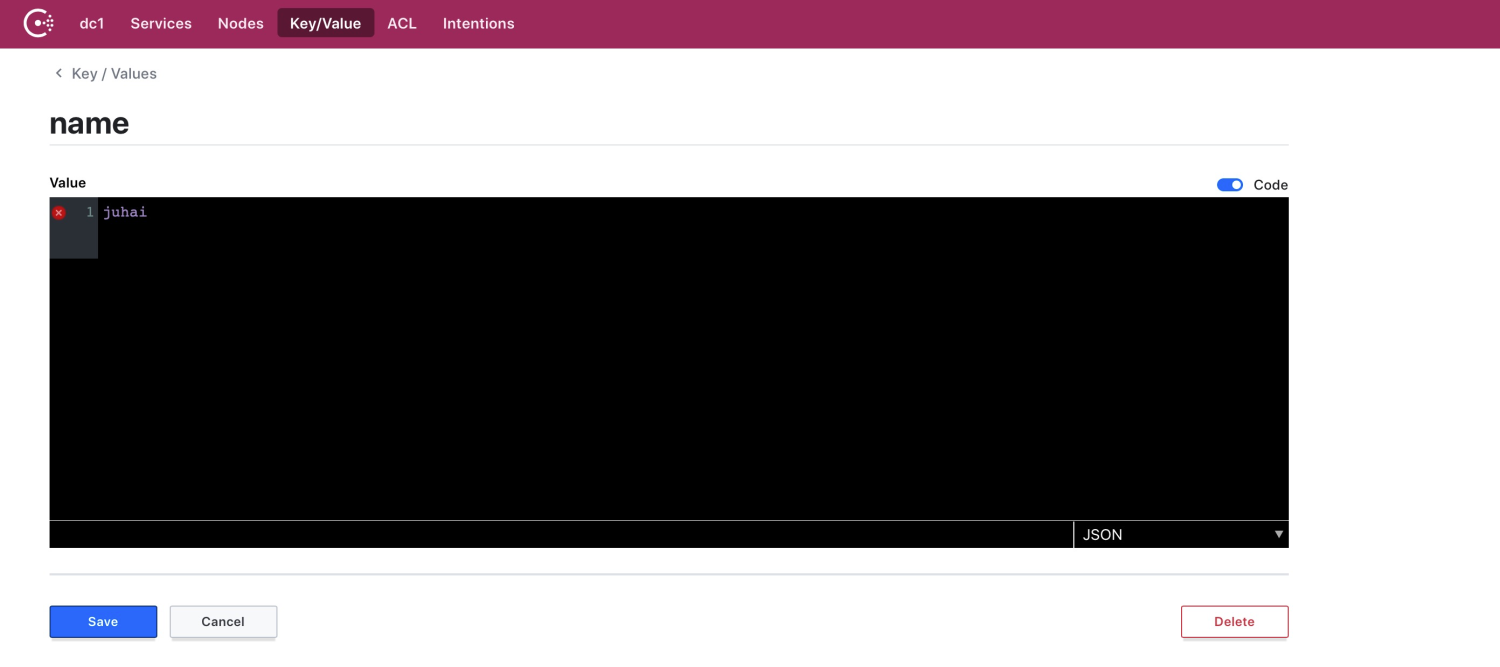
You can set configuration via kv.set and retrieve it via kv.get.
Note: Do not fetch configuration from Consul on every request at high QPS, which would overload the Consul server.
In high-QPS scenarios, cache config in a singleton and refresh periodically:
import { Init, Inject, Provide, Scope, ScopeEnum } from '@midwayjs/core';
import { ConsulService } from '@midwayjs/consul';

@Provide()
@Scope(ScopeEnum.Singleton)
export class ConfigService {

  @Inject()
  consul: ConsulService;

  config: any;

  @Init()
  async init() {
    setInterval(async () => {
      this.config = await this.consul.kv.get('name');
    }, 5000);
    this.config = await this.consul.kv.get('name');
  }

  async getConfig(){
    return this.config;
  }
}
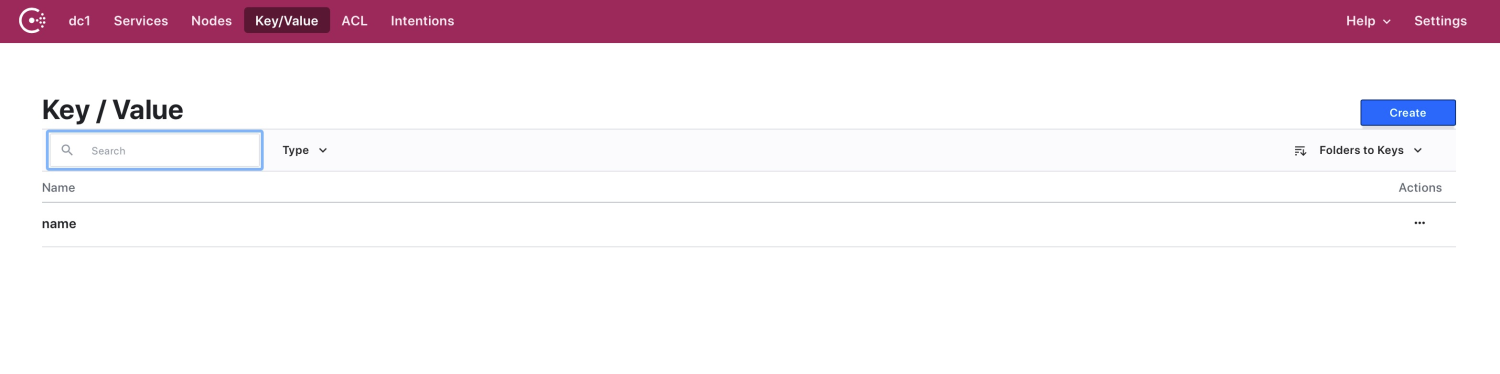
Consul interface examples:
Available methods: